
Major Players and Key Regions Shaping Liquid Transport Market Geopolitics
Several key players dominate the liquid transport landscape. The Middle East, with its vast oil reserves, continues to supply major portions of global crude, while the U.S. and Russia play leading roles in LNG and petroleum exports.
Corporations like Shell, BP, and Maersk are at the forefront, investing heavily in modern fleets and green shipping technology. Emerging economies in Asia are also expanding port infrastructures to compete in global logistics. This distribution of power forms the foundation upon which geopolitics exerts its influence.
The Influence of Geopolitics on Global Trade Routes
Geopolitics continuously redraws the world’s shipping map. When tensions rise between nations, vital trade routes can shift overnight. For instance, sanctions on specific countries may restrict tanker access or impose costly detours.
Furthermore, regional conflicts often push traders to secure alternative ports or overland pipeline routes. The control of maritime chokepoints—like the Strait of Hormuz or the Panama Canal—can either stabilize or disrupt liquid transport operations globally.
Maritime Chokepoints and Strategic Trade Corridors in Liquid Transport Market Geopolitics
Maritime chokepoints are narrow routes where a large share of liquid cargo passes. The Suez Canal, Strait of Hormuz, and Malacca Strait are three of the most significant. Any political instability in these regions can trigger major shipping delays and increased freight costs.
For example, when the Suez Canal was blocked in 2021, it disrupted nearly 12% of global trade. Governments and corporations are now investing in alternative routes and digital tracking systems to minimize risks.
Energy Politics and Its Direct Impact on Liquid Transport
Energy politics is the heart of how geopolitics affects the liquid transport market. OPEC’s decisions on production levels can shift freight demand globally, while sanctions against oil-producing countries like Iran or Venezuela reshape market flows.
When oil prices rise due to political conflicts, transportation costs follow. This ripple effect can increase consumer prices, strain supply chains, and force countries to diversify their import sources rapidly.
The Russia–Ukraine Conflict and Its Impact on Liquid Transport Market Geopolitics
The Russia–Ukraine war represents one of the most impactful geopolitical crises in modern liquid transport history. Europe’s reliance on Russian energy led to sudden redirection of LNG supplies from the U.S., Qatar, and Africa.
This conflict highlighted the vulnerabilities of overdependence on politically unstable regions. As a result, many European countries accelerated investments in new terminals and green energy corridors.
How Geopolitics Affects the Liquid Transport Market in Asia
Asia, being the world’s largest importer of oil and chemicals, is at the center of global liquid transport dynamics. Political tensions in the South China Sea or between China and Taiwan can instantly affect shipping insurance rates and route planning.
Asian nations are increasingly investing in regional alliances to secure energy flow stability. Japan, India, and South Korea, for instance, are diversifying their suppliers to minimize geopolitical exposure.
China’s Belt and Road Initiative as a Driver of Liquid Transport Market Geopolitics
China’s Belt and Road Initiative (BRI) is a clear example of geopolitics influencing the liquid transport market. Through port development, pipeline construction, and bilateral agreements, China is extending its reach across Eurasia and Africa.
This massive infrastructure project not only boosts trade but also enhances China’s control over strategic transport nodes, reshaping the global supply network.

Technological Adaptation and Risk Management in a Geopolitical Context
The intersection of technology and geopolitics defines the future of liquid transport. Companies are using AI, blockchain, and satellite tracking to manage risks in politically volatile regions.
Automation and predictive analytics allow logistics firms to reroute cargo and predict disruptions before they occur—turning technology into a shield against instability.
Insurance, Sanctions, and Compliance Challenges
Insurance firms now face complex challenges due to global sanctions and embargoes. Ships transporting liquid cargo must ensure full compliance with international regulations, or risk losing coverage.
Financial institutions are also tightening scrutiny on maritime transactions, adding another layer of geopolitical influence to the industry’s operational framework.
Future Outlook – How Geopolitics Will Shape the Liquid Transport Market by 2030
By 2030, geopolitics will continue to shape the liquid transport market through environmental policies, energy diversification, and new trade alliances.
As nations transition to renewable energy, traditional oil routes may decline, while new markets for hydrogen and biofuels emerge. Companies that adapt quickly to these geopolitical transformations will maintain resilience and profitability.
Green Policies, Sustainability, and Political Influence
Governments worldwide are prioritizing green shipping policies. Political pressure for carbon neutrality is pushing liquid transport firms to adopt cleaner fuels and efficient vessels.
Although compliance adds initial costs, it enhances long-term competitiveness and aligns with global sustainability goals—proving that politics and profit can coexist.
Strategic Recommendations for Industry Stakeholders
- Diversify supply chains to reduce exposure to volatile regions.
- Invest in digital resilience using AI and blockchain tracking.
- Engage in policy advocacy for transparent maritime regulations.
- Adopt green fuel technologies to stay ahead of political mandates.
Each step helps build a more stable and adaptable transport ecosystem amid geopolitical turbulence.
FAQs About How Geopolitics Affects the Liquid Transport Market
Q1: What is the biggest geopolitical risk for liquid transport?
A: Conflicts in oil-producing regions and trade sanctions pose the highest risks.
Q2: How do sanctions impact liquid shipping?
A: Sanctions restrict trading routes and increase insurance and compliance costs.
Q3: Can technology reduce geopolitical risk?
A: Yes, predictive analytics and AI-driven logistics can mitigate disruptions.
Q4: Which regions are most affected by geopolitical instability?
A: The Middle East, Eastern Europe, and the South China Sea are key hotspots.
Q5: How do oil prices relate to geopolitics?
A: Political tensions often drive price volatility, influencing freight costs globally.
Q6: What’s the future of the liquid transport market?
A: A shift toward renewable energy and smarter logistics will define the next decade.
Conclusion
The liquid transport market is deeply intertwined with global geopolitics. Every conflict, alliance, and policy shift creates ripples across shipping lanes and energy supply chains.
Businesses that understand these dynamics and adapt through technology, sustainability, and diversification will not only survive but thrive in the next era of global trade.
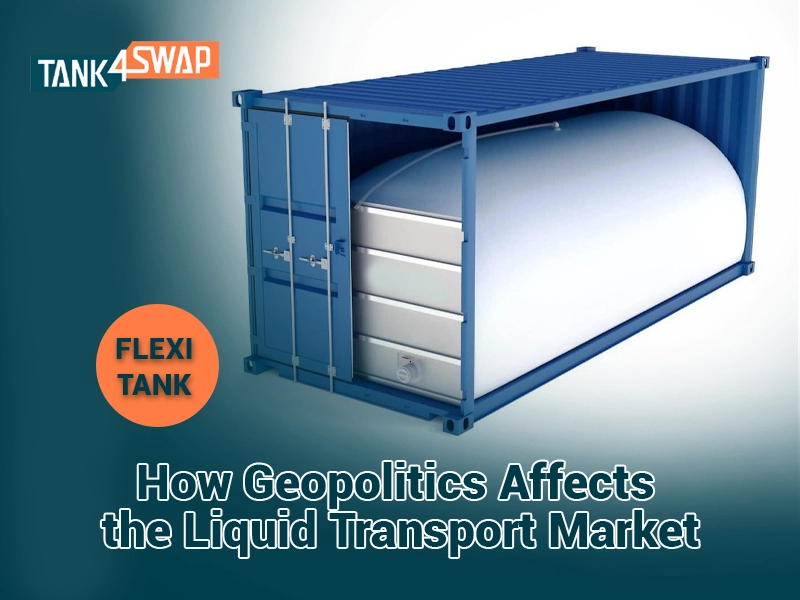
Get Professional Flexi Tank Solutions with TANK4SWAP
Searching for dependable Flexi Tank solutions to streamline your bulk liquid transport? At TANK4SWAP, we specialize in helping businesses choose the right Flexi Tank, manage logistics efficiently, and overcome technical challenges with ease.
Our experienced team provides personalized consultation and support, ensuring your liquid cargo moves safely, cost-effectively, and in full compliance with international standards. Whether you’re transporting food-grade liquids, chemicals, or industrial oils, TANK4SWAP delivers reliable, high-quality Flexi Tanks designed for diverse industry needs.
Why Partner with TANK4SWAP?
✔️ Expert Guidance – Receive customized advice tailored to your specific cargo and logistics requirements.
✔️ Comprehensive Support – Our specialists are available to assist with technical issues, transport planning, and risk management.
✔️ Smart Cost Solutions – Optimize your operations with durable, affordable, and efficient Flexi Tanks that enhance performance and reduce expenses.
📞Contact us:
Get in touch with TANK4SWAP today to discover how our team can provide the perfect Flexi Tank solution for your business. Let our experts make your bulk liquid transportation simpler, safer, and more profitable.
