
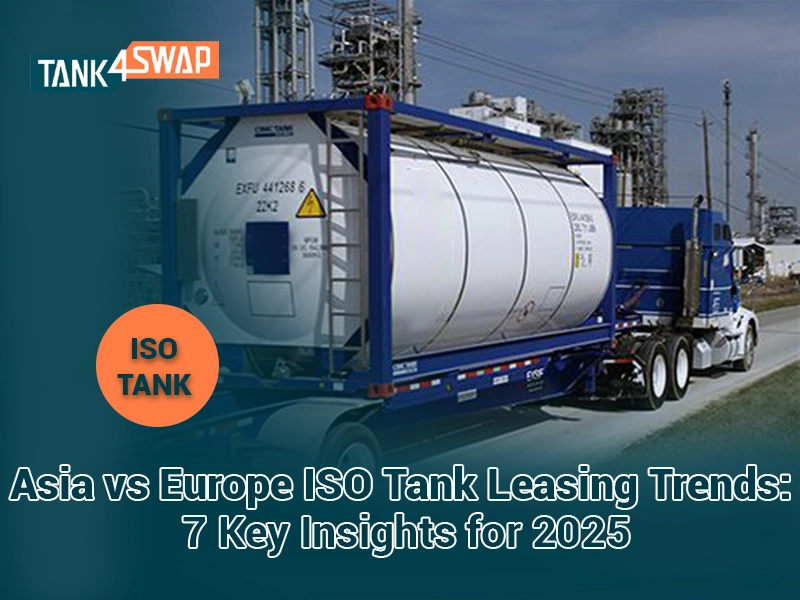
When discussing ISO tank leasing, we are essentially referring to the rental of standardized tank containers—often known as ISO tank containers—that fully comply with international ISO regulations for the transportation of bulk liquids. These tanks are widely used for chemicals, food-grade oils, and an increasing range of specialty products. Designed specifically for seamless intermodal transport across sea, rail, and road networks, ISO tanks play a critical role in global logistics, particularly when analyzing Asia vs Europe ISO Tank Leasing Trends, where demand patterns, regulatory environments, and industry growth show notable regional differences.
Leasing has become a preferred model because owning a full fleet of ISO tanks involves high capital expenditure, maintenance loads, cleaning/depots, regulatory compliance, and repositioning logistics. According to recent market research:
- A major reason for leasing dominance is the high upfront cost of tanks (often USD 100,000+ per unit) which makes ownership challenging for many smaller operators.
- Across the global market, leasing models allow companies to scale fleets up or down based on cargo demand, reducing idle assets and increasing flexibility.
- Key players include global lessors such as EXSIF Worldwide, Eurotainer SA, Seaco Global, and many regional specialists.
Understanding these fundamentals sets the stage for comparing how the Asia region versus the Europe region shape their tank-leasing ecosystems.
Market Size & Growth in Asia for ISO Tank Leasing
Asia’s ISO tank leasing market is booming due to industrialization, chemical exports, and better infrastructure. Countries like China and India drive demand, though regulatory differences and depot shortages remain challenges.
Market Size & Growth in Europe for ISO Tank Leasing
Europe has a mature, well-regulated leasing market. Strong intermodal networks and strict safety standards ensure stability, but competition and margin pressure are high.
Asia vs Europe ISO Tank Leasing Trends – Fleet Composition & Utilisation
Asia’s fleet is expanding faster, while Europe’s fleets are more efficiently used. Europe focuses on high-spec smart tanks; Asia emphasizes flexibility and growth.
Regulatory & Sustainability Drivers in Europe vs Asia ISO Tank Leasing
Europe’s strict environmental rules push for greener, compliant tanks. Asia’s regulations are improving but uneven. ESG and sustainability are becoming global priorities in leasing.
Digitalisation and Smart Tank Adoption in Asia vs. Europe
Europe leads in telematics and smart tank leasing. Asia is catching up quickly, integrating IoT and predictive maintenance into new fleets.
Cost Structures, Lease Models & Pricing Comparison
Asia prefers flexible, short-term leases with lower nominal costs but higher logistics expenses. Europe relies on long-term, service-inclusive leases with premium pricing.
End-Use Applications Driving Demand in Asia & Europe
In Asia, food-grade, chemical, and LNG sectors drive growth. In Europe, chemical and pharmaceutical industries dominate, with rising demand for specialty tanks.
Infrastructure & Depot Network – Asia vs Europe
Europe has mature depot and cleaning networks; Asia’s infrastructure is improving but still fragmented. Investments in depots and intermodal hubs are expanding across Asia.
Emerging Opportunities & Risk Factors in Asia vs Europe ISO Tank Leasing Trends
Asia offers high-growth potential but faces regulatory and logistical risks. Europe provides stable, mature demand but lower margins and strong competition.
Strategic Advice for Leasing Firms Operating Across Asia and Europe
Lessors in Asia should focus on flexibility and local infrastructure. In Europe, they should emphasize premium service, compliance, and digitalization. Cross-regional firms should balance both approaches.
Future Outlook – Asia vs Europe ISO Tank Leasing Trends to 2030
Asia is projected to grow around 9–10 % annually, while Europe grows modestly. Smart technologies and sustainability will drive both markets.

Case Study Snapshot – Asia and Europe Leasing Leaders
While not exhaustive, a brief snapshot helps illustrate real-world action.
Example in Asia:
A regional lessor in Southeast Asia expanding its fleet, building local depots, and leveraging IoT tracking to serve food-grade transport for exports.
They offer spot leases to exporters whose volumes fluctuate seasonally.
Example in Europe:
A European lessor specialising in chemical tank leasing with full service (cleaning, maintenance, telematics). They focus on major chemical hubs (Germany, Netherlands) and offer long-term leases with premium features.
What we can learn:
The Asia example shows growth, flexibility, infrastructure investment as key.
The Europe example shows service, compliance, premium features as key.
In both cases, digitalisation and infrastructure matter.
Summary – Key Takeaways on Asia vs Europe ISO Tank Leasing Trends
Asia is the faster-growing region for ISO tank leasing driven by industrial growth, exports, infrastructure build-out.
Europe remains a mature, stable and premium market with high utilisation, stronger regulations and service-led leasing.
Fleet composition, lease models, cost structures differ between Asia and Europe; lessors need tailored strategies.
Digitalisation, sustainability, infrastructure investment and regulatory compliance are common themes but manifest differently in each region.
For leasing firms, success means aligning with regional drivers: growth and flexibility in Asia; service and premium differentiation in Europe.
The future looks strong for both regions, but growth dynamics and risk profiles vary substantially.
FAQs on Asia vs Europe ISO Tank Leasing Trends
Q1: What is the primary difference between Asia & Europe ISO tank leasing trends?
A1: The primary difference is growth vs maturity – Asia is growing rapidly with flexible leasing models, infrastructure build-out and export demand, while Europe is more mature, service-oriented, with premium tank specifications and high utilisation rates.
Q2: Why is leasing preferred over owning ISO tanks in Asia and Europe?
A2: Leasing allows companies to avoid high upfront capital costs, manage variable demand, ensure regulatory compliance (especially in Europe), and leverage service-led models (cleaning, telematics) without owning the asset.
Q3: Which region has higher growth potential for ISO tank leasing?
A3: Asia-Pacific shows higher growth potential (for example ~9–10 % CAGR) compared to Europe’s more modest growth because Asia is still industrialising and expanding export capacity.
Q4: What role does digitalisation play in ISO tank leasing trends?
A4: Digitalisation (IoT sensors, telematics, real-time tracking) allows better asset utilisation, predictive maintenance, higher asset turnover and premium leasing rates. Both regions are adopting it, but Europe is more advanced and Asia is catching up.
Q5: How do regulatory & sustainability factors differ between Asia and Europe for ISO tank leasing?
A5: Europe has stricter regulatory frameworks (safety, environmental, emissions) and sustainability mandates, pushing leasing providers to offer newer, high-spec tanks. In Asia, regulation is improving, but is more varied, meaning leasing providers often must handle compliance across multiple jurisdictions.
Q6: Are the cost and lease-models different between Asia and Europe?
A6: Yes. In Asia, shorter-term leases, flexibility and variable demand dominate, but infrastructure and repositioning cost can be higher. In Europe, long-term leases with full-service are common, cost levels are higher but service and specification are superior.
Conclusion
In the battle between Asia vs. Europe ISO tank leasing trends, there is no single “winner” — each region brings distinct advantages. Asia offers rapid growth, dynamic demand and expansion potential; Europe offers stability, high-spec service, and mature infrastructure. Leasing firms, shippers and logistics stakeholders will succeed by tailoring their strategies to regional realities: build flexible, growth-oriented solutions in Asia; deliver premium, service-led offerings in Europe. The next decade promises considerable transformation—driven by digitalisation, sustainability, and global liquid-bulk trade shifts. Stay agile and region-aware, and you’ll be well-positioned.
Contact TANK4SWAP Today!
Looking for a smarter, safer, and more cost-efficient way to move bulk liquids or edible oils across regions? TANK4SWAP delivers the solution. Our premium Flexi Tanks and ISO Tanks are engineered for maximum efficiency, zero contamination risk, and lower overall logistics costs.
From Asia to Europe, we help clients streamline global transport operations with expert guidance on tank selection, route optimization, and full food-grade compliance. Our experienced team ensures every shipment runs smoothly — from loading to final delivery.
Don’t compromise on safety or quality. Partner with TANK4SWAP today and discover a new standard in reliable, cost-effective bulk liquid logistics. 🌍🚀
